
Background
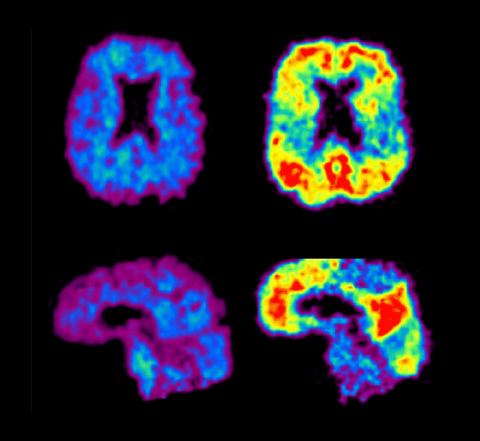
There is increasing interest in using genetic tests and other biomarkers to identify individuals at risk for Alzheimer’s disease (AD). One of these biomarkers is a protein called “amyloid” that can build up and form deposits, called “plaques,” in the brain. Investigators believe that the buildup of amyloid in the brain may play a key role in the later development of AD. Doctors can measure amyloid buildup that may occur many years before cognitive symptoms are present by using a PET scan. However, given the current limitations of predictive testing and AD treatment capabilities, there is much debate about how and whether to disclose such risk information.
The Risk Evaluation and Education for Alzheimer’s Disease – the Study of Communicating Amyloid Neuroimaging, or REVEAL-SCAN, is the fifth study in a series of multi-site randomized clinical trials. These trials have examined the psychological and behavioral impacts of providing AD risk assessment to asymptomatic populations. With sites at Harvard Medical School (Brigham & Women’s Hospital), Duke University, the University of Pennsylvania, and the University of Michigan, the purpose of this study is to learn about the best ways to communicate educational information about amyloid brain scans to asymptomatic older adults at an elevated risk for AD. Data collection for this study is now complete. The data collected from this study is currently being analyzed, and papers are being written based on the results.
Study Aims
The REVEAL-SCAN study aims to: (1) examine the impact of learning amyloid imaging results in cognitively normal individuals to determine, (2) if an individual’s knowledge of their amyloid biomarker status will bias their thinking and memory, and (3) whether such knowledge will prompt beneficial behavioral changes or cause adverse psychological consequences.
Funding Source
The REVEAL-SCAN study was funded by an RF1 grant (AG047866) from the National Institute on Aging (NIA) within the National Institutes of Health (NIH).
Key Personnel
Scott Roberts, PhD, Site Principal Investigator; overall project Co-Principal Investigator
Wendy R. Uhlmann, MS, CGC, Co-Investigator; Study Clinician
Rebecca Ferber, MPH, Study Coordinator
Sara Feldman, MPH, Predoctoral Fellow
Sarah McCain, MPH, U-M Project Manager
Study Publications
Karlawish J, Harkins K, Chen CA, Cupples LA, Roberts JS, Welsh-Bohmer KA, Green RC. How Knowledge of Elevated Amyloid Impacts Neuropsychological Performance in Cognitively Normal Older Adults: Findings from the REVEAL SCAN Study. Alzheimer’s & Dementia. 2021. PDF.
Roberts JS, Patterson A, Uhlmann W. Genetic Testing for Neurodegenerative Diseases: Ethical and Health Communication Challenges. Neurobiology of Disease. 2020;141. PDF.
Largent EA, Abera M, Harkins K, Roberts JS, Karlawish J, REVEAL-SCAN Team. Study Partner Perspectives on Disclosure of Amyloid PET Scan Results. Alzheimer’s & Dementia. 2020. PDF.
Roberts JS, Dunn LB, Rabinovici GD. Amyloid Imaging, Risk Disclosure and Alzheimer’s Disease: Ethical and Practical Issues. Neurodegenerative Disease Management. 2013;3(3):219-229. PDF.
 Roberts Research Group